
(3 mins read)
During the last decade, personal development has been significantly disrupted. In the past, we had to face challenges related to the fear of the unknown, overcoming deeply ingrained habits, learning new skills, meeting new people, or exploring new geographies and cultures. Recently, new challenges have emerged. One such challenge is navigating the complexities of the digital age with constant connectivity and information overload. The next one is the pressure to constantly optimize and improve in a fast-paced society, which can lead to unrealistic expectations and burnout. Another emerging challenge is the need to compete with rapid technological innovation like A.I.
There are two critical elements that play a significant role when we talk about PERSONAL DEVELOPMENT in the future. The first one is to have a GROWTH MINDSET, and the second is to find comfort beyond a COMFORT ZONE.
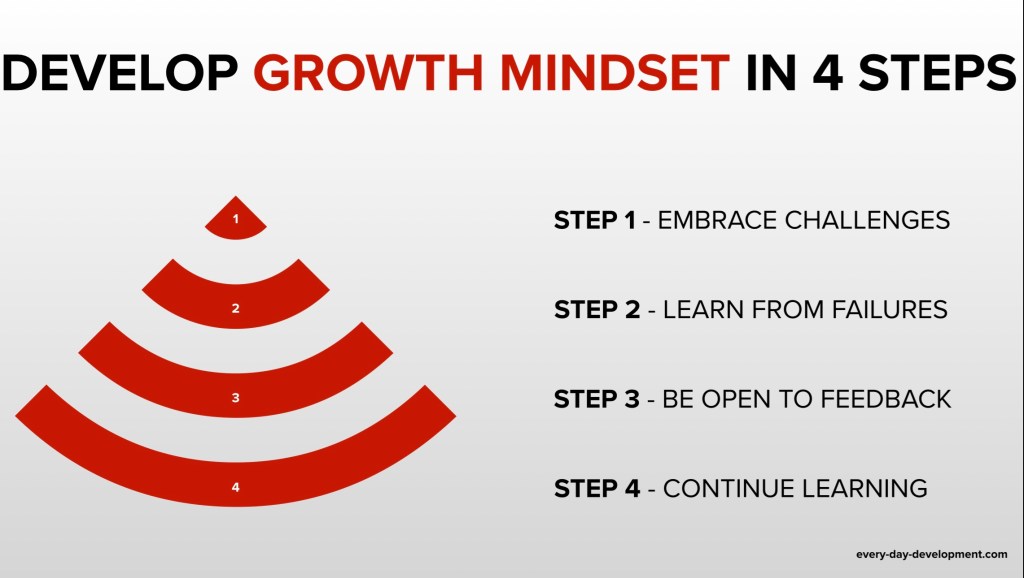
A GROWTH MINDSET means that through consistent challenge, practice, and effort, we could change, adjust, and grow. Below is a four-step process that will help you develop a growth mindset.
STEP 1 – EMBRACE CHALLENGES
First, and the most important, is that you need to see challenges as opportunities for growth rather than obstacles or problems. This is the most difficult part of the process because we may face a significant emotional element of change. You might also be scared of leaving your comfort zone and jumping into a new or unknown area.
STEP 2 – LEARN FROM FAILURES
So far, your experience with failures was not positive. When you failed at school, you received a low rating or even did not pass the exam. At work, failure meant a lower or no bonus, and in some drastic situations, contract termination. Now, you need to change your perspective 180 degrees and recognize that during your developmental journey, there will be many setbacks. You need to learn how to reflect and learn from them. This perspective encourages resilience and perseverance. It will help you bounce back from failures and avoid similar situations in the future.
STEP 3 – BE OPEN TO FEEDBACK
Open your ears for any feedback, positive and constructive. It’s the basis for improvement. You will hear from others what is working and what requires continuous work. Disconnect personally and emotionally and focus on specific tasks or behaviors. It will help you navigate the discomfort associated with facing constructive feedback.
STEP 4 – CONTINUE LEARNING
First, you need to understand that the river of information, innovation, new technologies, and new ways of living or working will never stop. When we graduate, we often think that our education is over. After some time, we come to the conclusion that if we are interested in personal development, we need to continue our learning journey. We become lifelong learners who actively seek out fresh perspectives, new information, and challenges.
The above 4-step process will help you build your growth mindset, which supports a positive and proactive approach to future challenges, failures, and lifelong learning.
The second element, which is linked to personal development, is finding comfort beyond a COMFORT ZONE. First, you need to understand more about your preferences, experience, and limits. Answering the questions below will help you reflect and find the right level of challenges you are capable of dealing with. If the level of challenges is too low, you will not be stimulated enough, and your potential will not be explored. However, if you go too far or face too many or too significant challenges, there is a high probability that you will fail or burn out. There are some people who can deal with multiple personal or professional challenges. They can change geographies, cultures, countries, schools, jobs, industries, functions, or bosses at the same time. But not everyone can be a member of a S.W.A.T. team. Some people can deal with one or a few challenges simultaneously.
- When was the last time you tried something new or stepped outside your routine?
- How do you react when faced with unexpected challenges or changes?
- Do you find yourself avoiding certain situations or opportunities due to fear or discomfort?
- Are you willing to take calculated risks in pursuit of your goals, or do you prefer to play it safe?
- How often do you set goals that challenge your current skill set or knowledge?
- When faced with uncertainty, do you lean towards embracing the unknown or seeking stability?
These questions can serve as a starting point for self-reflection and help you gauge your comfort levels in various aspects of your life.

In conclusion, the journey of finding comfort beyond our comfort zone is a transformative and empowering experience. Exploring the unknown, facing challenges, and embracing change will bring you where you want to be. And remember, growth often begins at the edge of your comfort zone.
**********
 Every Day Development